




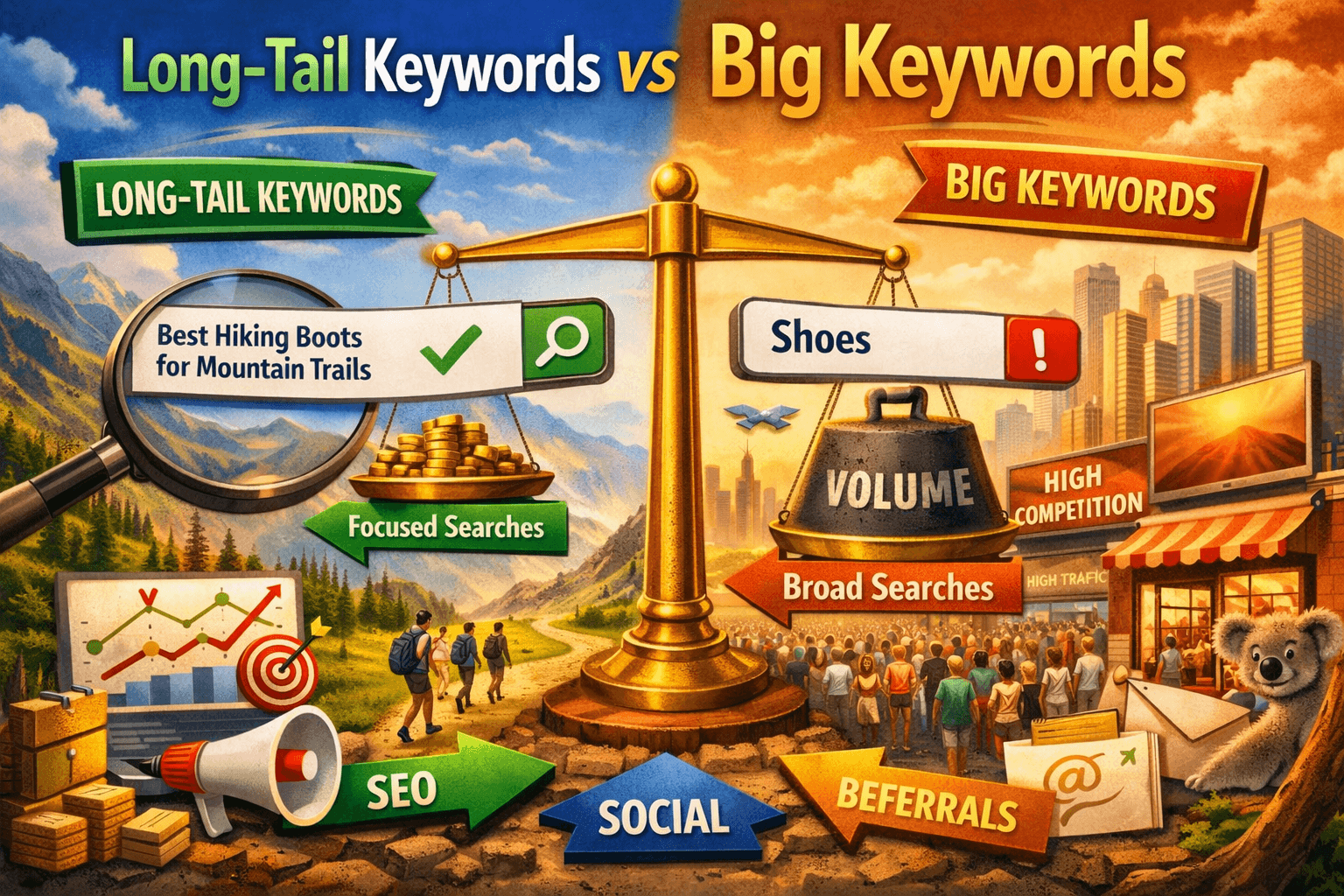
Most website owners chase the same big keywords. They want to rank for “shoes,” “digital marketing,” or “insurance.” The logic seems sound: more searches mean more visitors. But this approach rarely works the way people expect it to.
Big keywords are competitive, expensive, and often attract the wrong audience. Long-tail keywords, which are longer and more specific phrases, tend to do the opposite. They bring fewer visitors in raw numbers, but those visitors are more likely to buy, subscribe, or take action.
This article explains how long-tail keywords work, why they outperform broad terms for most websites, and how you can use them to build traffic that actually converts.
Why Big Keywords Attract Attention but Often Miss Intent
A broad keyword like “running shoes” gets millions of searches each month. That number looks appealing. But who is searching that term? Some people want to buy shoes. Others are looking for reviews. Some want to know the history of running shoes. Others are doing school research. One keyword, many different intentions.
When someone types “running shoes,” Google has to guess what they actually want. The results end up being a mix of content types. You compete with Nike, Adidas, major review sites, and established media outlets. Your small or mid-size website has almost no chance of ranking on page one.
Even if you did rank, your conversion rate would be low. The visitor who searched “running shoes” is not ready to buy yet. They are browsing. They have not decided what they want. They will likely leave your page without taking any action.
This is the core problem with big keywords. High search volume does not equal high-quality traffic. It often means high bounce rates and wasted ad spend.
According to data from Ahrefs, the top 1,000 most popular keywords account for less than 1% of all searches. The remaining 99% of searches are made up of longer, more specific queries. That is where your real opportunity sits.
How Long-Tail Keywords Match Specific Search Needs
A long-tail keyword is a search phrase with three or more words. It is specific. It reflects what the person actually wants.
Instead of “running shoes,” a long-tail version might be “best running shoes for flat feet women” or “lightweight running shoes for marathon training under $100.” These searches tell you exactly what the person needs. They have intent. They have context. They are ready to make a decision.
This specificity changes everything about how you write content and who finds it.
When your page matches a specific search query precisely, Google rewards you with a higher relevance score. You do not need to be a domain authority powerhouse to rank for a specific phrase. A well-written, focused page can rank on page one for a long-tail keyword within weeks, even on a newer website.
Some SEO teams also use a traffic bot to test how visitors interact with pages optimized for specific long-tail queries. This lets them measure engagement patterns and refine content layout before scaling a full keyword strategy. It is one way to validate that your page structure works before investing in links or broader promotion.
Real example: Zapier, the automation platform, built a large portion of its traffic by targeting hundreds of specific integration keywords. Instead of going after “automation software,” they created pages for “connect Gmail to Slack,” “automate Google Sheets,” and thousands of similar phrases. Each page ranked easily for a low-competition term. Combined, those pages brought millions of monthly visitors who were already looking for exactly what Zapier offers.
That strategy works because the keyword matches the content, which matches the user intent. There is no gap.
Why Specific Keywords Bring More Qualified and Engaged Visitors
When someone searches a long-tail keyword, they are further along in the decision process. They are not exploring. They are evaluating or ready to act.
A person who searches “best CRM for freelancers under $30 per month” has already decided they need a CRM. They have a budget. They know they are freelancers. When they land on a page that speaks directly to their situation, they stay. They read. They click.
This is what qualified traffic looks like. It converts at a higher rate because the match between what they searched and what they found is precise.
A study by Moz found that long-tail keywords convert at three to five times the rate of short, broad keywords. The reason is simple: specificity signals intent, and intent drives action.
Real example: HubSpot consistently targets long-tail questions for its blog. Instead of only targeting “email marketing,” they publish articles like “how to write a follow-up email after no response” or “email marketing tips for small nonprofits.” These pages rank quickly because they face less competition. They bring in readers who are dealing with a specific problem right now, which makes them more likely to sign up for HubSpot’s free tools.
Long-tail traffic is also more durable. When Google updates its algorithm, broad keyword rankings often swing dramatically. But pages built around specific, intent-driven phrases tend to hold their positions. The content is so relevant to the search that Google has little reason to demote it.
Key takeaway: Qualified traffic from long-tail keywords costs less to acquire and produces better results than mass traffic from big keywords.
How to Use Long-Tail Keywords to Build Sustainable Website Traffic
Building a long-tail keyword strategy is straightforward. You start with a topic, find specific angles within it, and create focused content for each one.
Here is a practical process:
Step 1: Start with your core topic Pick the main subject your website covers. For a fitness brand, that might be “weight training.” For a legal service, it might be “employment law.”
Step 2: Use keyword research tools to find specific phrases Tools like Ahrefs, Semrush, and Google Search Console show you the actual phrases people type. Filter for keywords with three or more words and low keyword difficulty scores. Look for phrases with clear commercial or informational intent.
For example, a legal services firm might find: “what to do if your employer underpays you,” “how to file a wage complaint in California,” or “employment lawyer fees for wrongful termination.” Each of these is answerable, specific, and searchable.
Step 3: Map one keyword to one page Do not try to target five long-tail keywords on a single page. Create a focused page for each main intent. This gives Google a clear signal about what each page covers.
Step 4: Answer the full question Long-tail searchers want complete answers. Write content that covers the topic thoroughly. Include related questions, examples, and clear next steps. Pages that fully satisfy the search intent rank higher and keep visitors on the page longer.
Step 5: Build consistently over time The power of long-tail keywords comes from volume. One page targeting a specific phrase might bring 50 visitors per month. Fifty pages targeting fifty different phrases can bring 2,500 visitors per month. That scales without requiring you to compete for the hardest keywords in your industry.
Real example: NerdWallet built one of the largest personal finance websites in the United States by targeting thousands of specific financial questions. Pages like “what credit score do you need to buy a car” or “best savings account interest rates for college students” each rank for a low-competition query. Together, they generate tens of millions of monthly visits. NerdWallet did not start by trying to rank for “credit cards.” They started with specifics and built outward.
What to avoid:
- Do not target long-tail keywords that have no real search volume. Use tools to confirm actual demand before writing.
- Do not stuff multiple unrelated long-tail keywords into one page. It confuses both readers and search engines.
- Do not ignore search intent. A keyword with informational intent needs an informative article, not a product page.
Long-tail keywords are not a workaround or a shortcut. They are a more accurate way to connect your content with the people who actually need it. You skip the competition. You attract visitors who are ready to engage. You build rankings that last.
Big keywords make sense for brands with large budgets and established authority. For everyone else, long-tail keywords are the faster, more reliable path to traffic that produces real results.
Start with ten specific phrases in your topic area. Create one focused page for each. Measure the traffic and conversion data after 90 days. You will see the difference clearly.