



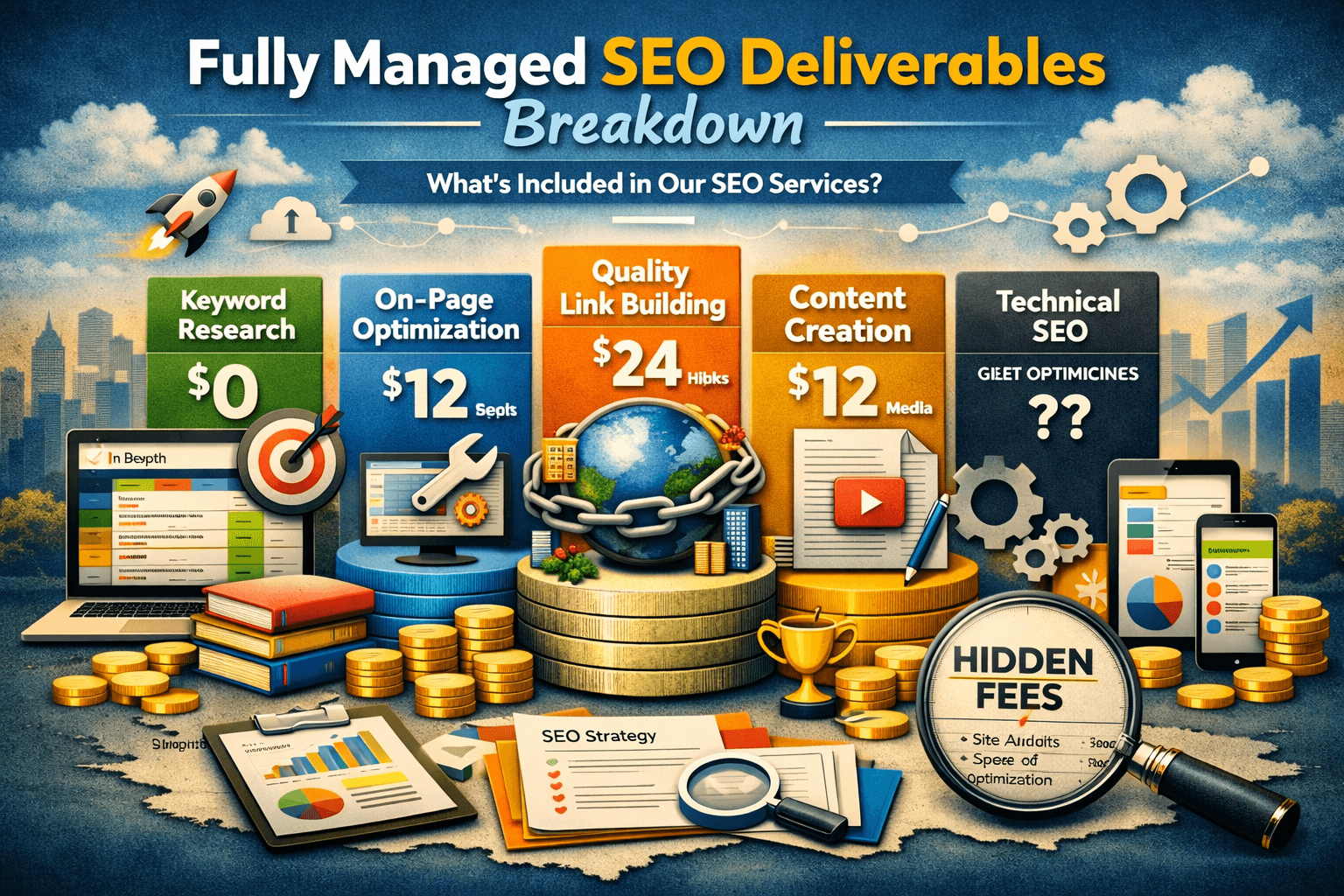
Most businesses paying for fully managed SEO services don’t know exactly what they’re getting each month. This guide changes that. You’ll learn what a typical managed SEO plan covers, what to look for in your monthly reports, and how to tell whether your investment is actually working.
What “Fully Managed SEO” Actually Means
Fully managed SEO means you can step back while professionals handle your SEO from beginning to end. There’s no need to manage different people or worry about technical details.
Think of it as hiring a team that takes care of everything for you — and keeps you informed without using confusing jargon.
Core Deliverables: A Category-by-Category Breakdown
Here is what a legitimate, fully managed SEO services engagement should include across every major category.
Technical SEO Auditing and Fixes
Technical SEO is the foundation. Without it, even the best content won’t rank.
What Gets Audited
A thorough technical audit covers the following:
- Site crawlability — Can search engines find and index all key pages?
- Page speed — Core Web Vitals scores across desktop and mobile
- Crawl errors and broken links — 404s, redirect chains, and dead-end URLs
- Duplicate content — Canonical tag issues, parameter-based duplicates
- XML sitemap and robots.txt — Are they configured correctly?
- Schema markup — Structured data for rich results eligibility
What Gets Fixed
An SEO audit only tells you what’s broken. A good managed SEO provider actually fixes it. That means updating meta tags, cleaning up broken redirects, and submitting fresh sitemaps through Google Search Console — so search engines can find and rank your pages faster. Before choosing a provider, businesses can run a quick check with SuperioTech’s free SEO audit tool to spot technical issues and see where their site currently stands.
Keyword Research and Search Intent Mapping
Traffic only matters if it’s the right traffic. Keyword research connects your content to real searches, not guesswork.
How It Works
Find your main keywords, expand them with SEO tools, then narrow the list based on difficulty and relevance. Organize them by search intent to shape your content.
Why Search Intent Matters
If your content doesn’t match what users expect, they leave. Simple as that. Aligning with intent turns clicks into actual results.
On-Page SEO Optimization
On-page SEO is about making each page on your site as easy as possible for both Google and your visitors to understand. Here’s what gets worked on every page:
- Title tags and meta descriptions — written to target the right keywords and get more clicks from search results
- Headings (H1–H3) — structured so the page is easy to read and easy for Google to scan
- Internal links — added strategically so your pages support each other and pass authority across your site
- Image alt text — descriptive tags that help with accessibility and give Google more context
- Clean URLs — short, readable, and built around your target keywords
- Content optimisation — pages are updated to match what people are actually searching for
Every page follows the same optimisation checklist so nothing gets missed.
Content Strategy and Creation
Content is how a site earns rankings for new keywords and builds topical authority over time.
The Content Planning Process
Your competitors aren’t publishing content randomly — and neither should you. A managed SEO provider uses a proven content strategy to help your site earn more visibility over time.
- Content gap analysis — spotting the exact topics your competitors rank for that you’re missing out on
- Topic clustering — building interconnected content hubs that signal deep expertise to search engines
- Editorial calendar — a structured publishing schedule that keeps content consistent and on track
- Content briefs — clear, research-backed outlines so every piece targets the right keywords and answers the right questions
What Gets Produced
Deliverables vary by package but typically include a set number of optimized blog posts, landing pages, or service pages per month. Each piece is written to target specific keywords and satisfy search intent.
Link Building and Off-Page Authority
Links from other websites signal to search engines that a site is credible and authoritative. This is one of the most impactful — and most misrepresented — areas of SEO.
- Guest posting on relevant, high-authority industry publications
- Digital PR — Earning coverage and links through newsworthy content or data
- Resource link building — Getting listed on industry directories and resource pages
- Broken link outreach — Replacing dead links on external sites with relevant content
Local SEO
If your business serves a specific city or region, local SEO is one of the most important things you can invest in. It helps you show up when nearby customers search for what you offer.
- Google Business Profile optimisation — making sure your business name, address, phone number, categories, and photos are accurate and up to date
- Local citation building — listing your business consistently across directories like Yelp, Bing Places, and Apple Maps
- Review strategy — guidance on how to get more customer reviews and how to respond to them professionally
- Localised content — pages and posts written to rank for searches in your specific city or region
Reporting and Performance Tracking
Transparent reporting is what separates professional SEO management from guesswork.
- Organic traffic trends — Month-over-month and year-over-year comparisons
- Keyword ranking movement — Which keywords are rising, holding, or declining
- Backlink profile summary — New links earned, lost links, and domain authority changes
- Conversion tracking — Are organic visitors taking meaningful actions on the site?
- Technical health snapshot — Outstanding issues and resolved fixes from the month
Reports should be readable by a non-technical business owner. If a client can’t understand the report, the provider hasn’t done their job.
Strategy Reviews and Communication Cadence
SEO isn’t a set-it-and-forget-it channel. Strategies need to adapt to algorithm updates, competitive shifts, and business changes.
- Monthly strategy calls or written strategy notes
- Proactive communication when Google updates affect performance
- Quarterly reviews to reassess keyword targets, content priorities, and technical goals
- A single point of contact who understands the client’s business
Clients should never feel like they’re chasing their SEO provider for updates.
What Fully Managed SEO Typically Does Not Include
Setting expectations is part of honest service delivery. Most fully managed SEO engagements do not cover:
- Paid advertising (Google Ads, Meta Ads) — a separate channel
- Social media management — unless explicitly included in the scope
- Website redesigns or CMS migrations — may require additional project work
- Immediate results — SEO is a 6–12 month investment before meaningful traffic gains are typical
Understanding what’s excluded prevents misaligned expectations on both sides.
How to Evaluate an SEO Provider’s Deliverables
Picking the right SEO provider takes more than a Google search. Here are five simple questions worth asking before you decide:
- What exactly do I get each month? The answer should be specific — not “we’ll work on your SEO.”
- Who’s actually doing the work? In-house teams and outsourced work can be very different in quality.
- How do you approach link building? Ask to see examples — ethical link building matters more than volume.
- 4. Can I see a real report? A sample report shows you how they track progress and keep you in the loop.
- How will we measure results? Look for clear benchmarks tied to real business goals.
If something feels off in their answers, trust that feeling.
Ready to See What Managed SEO Looks Like in Practice?
You deserve to know exactly where your SEO investment is going. BrandLume’s fully managed SEO services keep things transparent, with clear deliverables, simple reports, and a strategy you can actually understand.
That means no guesswork and no unclear tactics. Just a straightforward process focused on improving organic rankings in a way you can track and measure.
If your content doesn’t match what users expect, they leave. Simple as that. Aligning with intent turns clicks into actual results.