



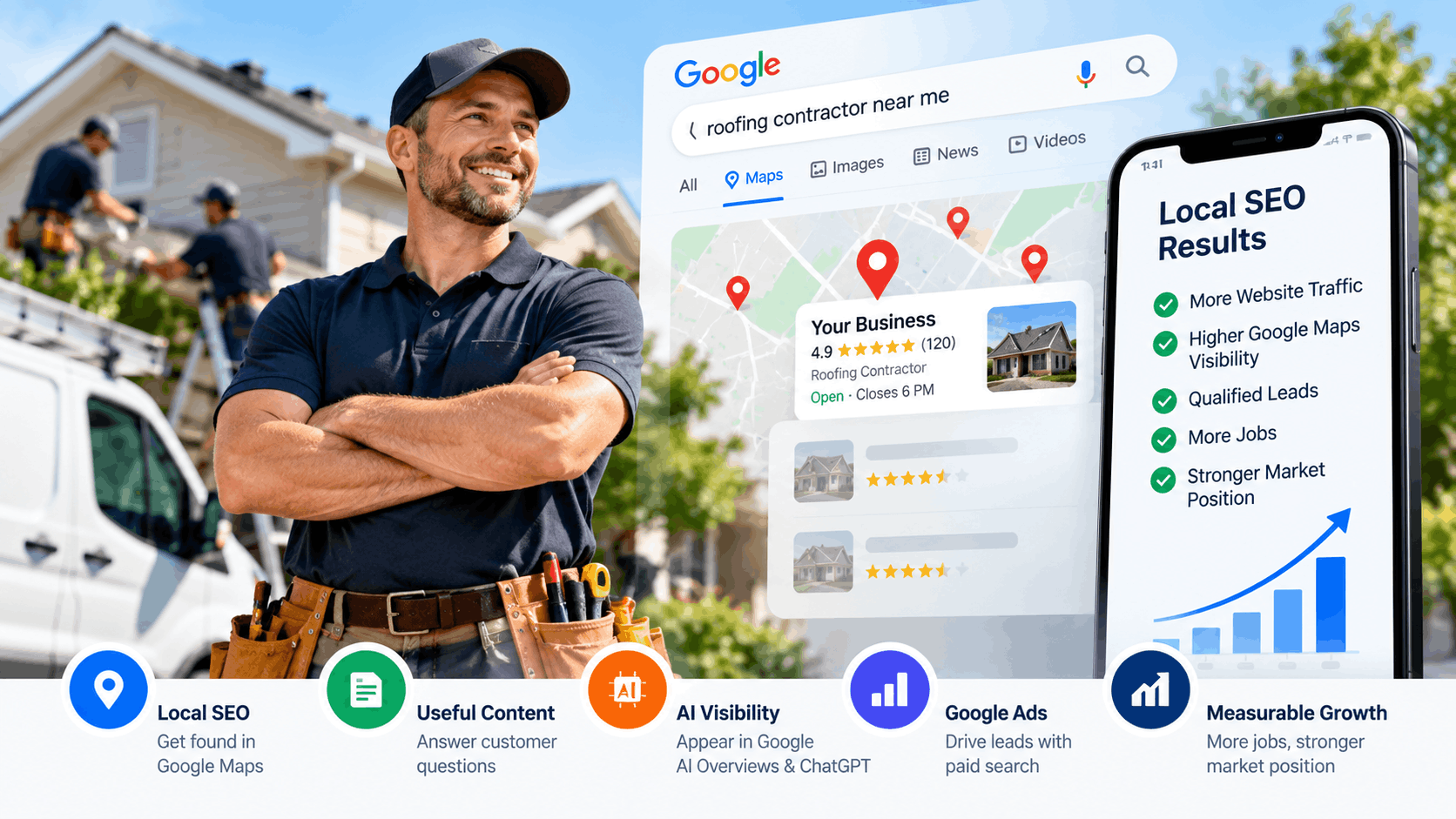
For contractors and service businesses, online visibility is closely connected to the ability to generate new inquiries. A homeowner who needs a roofer, plumber, HVAC technician, landscaper, electrician, or restoration company will often begin the process with an online search.
However, simply having a website does not mean potential customers will find it. Businesses need to make their services, locations, experience, and contact information easy for both customers and search platforms to understand.
This is where local search engine optimization (SEO) becomes important. A well-planned local SEO strategy can improve how a service business appears across traditional Google search, Google Maps, and other digital discovery experiences.
As search behavior continues to evolve, businesses also need to consider how their information may be discovered through AI-assisted platforms and answer-based search experiences.
What Is Local SEO for Service Businesses?
Local SEO is the process of improving a company’s online presence so that people searching for relevant services in a particular geographic area can find and evaluate the business.
For example, someone experiencing a leaking pipe is unlikely to search broadly for information about plumbing companies across the country. They may search for terms such as “plumber near me,” “emergency plumber,” or a plumbing service combined with their town or city.
Google then has to determine which businesses and webpages may be relevant to that search.
Local SEO can involve optimizing service pages, improving website structure, maintaining accurate business information, developing useful content, managing a Google Business Profile, earning credible online references, and measuring how visitors interact with the website.
The objective should not simply be higher rankings. For most contractors, the real objective is attracting people who genuinely need the services the company provides.
Start With the Services You Actually Want to Grow
One mistake businesses can make with SEO is treating every keyword as equally valuable.
A roofing company, for example, may offer roof repair, replacement, inspections, storm-damage work, and commercial roofing. Some of these services may be more profitable or strategically important than others.
SEO research can therefore begin by determining which services the company wants to grow and where it can realistically provide them.
The website can then be organized around these priorities.
Instead of publishing large amounts of generic content, businesses can create useful service pages that explain what they offer, who the service is suitable for, common customer questions, relevant limitations, service areas, and how to request an estimate or consultation.
This gives potential customers more information to make a decision while helping search systems understand the purpose of each page.
Google Maps Is an Important Part of Local Discovery
For many local searches, Google’s map results are highly visible.
That makes a well-maintained Google Business Profile an important part of a contractor’s online presence.
Business names, categories, hours, service information, photographs, website links, and other profile details should accurately represent the company. The information presented on the profile should also be consistent with the business’s website and other credible online references.
Customer reviews can provide additional context for people evaluating a company. Rather than viewing reviews purely as a ranking tactic, service businesses should recognize their broader role in the buying process.
A prospective customer may compare several contractors before making contact. Clear business information, genuine reviews, useful website content, and an easy contact process can collectively make that decision easier.
Useful Content Can Turn Search Visibility Into Opportunities
Getting a page discovered is only the first part of the process.
Once someone reaches a website, the content has to answer the questions that brought the visitor there.
A potential HVAC customer might want to know whether a system should be repaired or replaced. A homeowner researching roofing may want to understand materials, expected project stages, warranties, or how estimates work.
These are opportunities to create content around genuine customer needs.
Useful content can include service explanations, FAQs, comparisons, cost considerations, maintenance information, project examples, and guides addressing common problems.
Search Geek Solutions applies this broader approach to contractors and service companies, combining local search, useful content, Google Maps visibility and measurement. Businesses interested in exploring the company’s approach can visit Search Geek Solutions. The company describes its methodology as “SEO as Science,” using research and measurement to help shape search priorities around a business’s services and market.
The important principle is relevance. Content should exist because it helps prospective customers understand something useful, not merely because another keyword can be added to the website.
Technical SEO Still Matters
Good content can underperform when the website itself creates unnecessary obstacles.
Technical SEO helps search engines access, interpret, and organize website content. It also overlaps with usability in areas that matter directly to visitors.
A service business should pay attention to mobile usability, page performance, internal linking, crawlability, indexing, page structure, redirects, and structured data where appropriate.
Mobile experience deserves particular attention because customers searching for an immediate local service may be using a smartphone.
Phone numbers and contact options should be easy to locate. Forms should not be unnecessarily complicated, and important service information should not be buried beneath distracting design elements.
The website should make the next action clear.
Local SEO Is Expanding Beyond Traditional Search Results
Search discovery is also changing.
Customers can now ask detailed questions through AI-assisted search experiences rather than typing only short keywords into a traditional search box.
Google AI Overviews and conversational tools such as ChatGPT have added another layer to online research.
This does not mean conventional SEO has become irrelevant. Instead, many of the fundamentals remain useful: clear business information, accessible webpages, direct answers, credible evidence, strong service descriptions, and consistent information across relevant sources.
Search Geek Solutions, for example, describes AI-search work as supporting its existing local SEO foundation rather than replacing it. The agency explicitly notes that inclusion, citations, and rankings in AI systems cannot be guaranteed.
That distinction matters because businesses should be cautious about anyone promising guaranteed placement within AI-generated answers.
SEO and Google Ads Can Support Different Stages of Growth
Organic search is only one way of reaching customers.
Google Ads can complement SEO by allowing businesses to compete through paid search for selected services and markets. SEO, meanwhile, can focus on developing the website, local presence, content, and organic visibility over time.
The two channels can also produce useful information for one another.
Paid campaigns may reveal which searches or services generate valuable inquiries, while organic search data can identify customer questions and areas where stronger content is needed.
The appropriate balance depends on the business, competition, location, budget, and growth priorities.
Measure More Than Rankings
Rankings can be useful indicators, but they do not tell the whole story.
A contractor ultimately needs customers rather than ranking reports.
Measurement should therefore consider relevant website traffic, calls, contact forms, quote requests, booked appointments, and other meaningful actions where tracking is available.
Businesses can then ask more useful questions: Which services generate inquiries? Which locations produce appropriate leads? Which pages help visitors take the next step? Are marketing efforts attracting the type of work the business actually wants?
Search Geek Solutions describes a similar evidence-led process in which search demand, competitor information, conversion data, website improvements, business profiles, and measurement inform ongoing priorities.
Final Thoughts
Local SEO works best when it is connected to genuine business objectives.
For contractors and service businesses, that means identifying the services worth growing, making business information easy to verify, answering customer questions clearly, strengthening local visibility, maintaining a usable website, and measuring whether that visibility produces meaningful inquiries.
Google Maps, traditional organic search, paid search, and emerging AI-assisted discovery can all play roles in how customers find service providers.
The technology will continue to change, but the underlying objective remains straightforward: help the right customers discover the business, understand what it offers, and confidently take the next step.