




A guest-post prospect has a Domain Authority of 48 and a Spam Score of 67%. The site looks polished, publishes every day, and offers a dofollow link for a flat fee. One number says “strong.” Another says “risky.”
Neither number makes the decision.
I use Spam Score to decide what I should inspect next. It is a pattern-matching metric from Moz, not a Google warning, manual action, or penalty report. A high value can surface a bad link source. It can also flag a legitimate site whose structure happens to resemble sites in Moz’s spam model.
That uncertainty is useful. It keeps the score in its proper role: triage.
What Spam Score measures
Moz Spam Score runs from 0 to 100. A higher percentage means Moz sees more characteristics associated with sites that have been penalized or deindexed in its training data. It does not mean Google has reviewed the domain or assigned the same percentage.
The common reading bands are straightforward:
- 0–30: low-risk band
- 31–60: medium-risk band
- 61–100: high-risk band
I treat those bands as queue labels. Low moves forward to a normal review. Medium gets extra checks. High usually goes into a rejection or deep-review lane, depending on the value of the opportunity.
The same score can mean different things in different contexts. A medium score on a large forum, nonprofit directory, or user-generated platform may come from structural patterns. The same score on a thin guest-post site with hundreds of unrelated commercial articles deserves far less patience.
Why a low score can still hide a bad domain
Spam models depend on the data available to them. A new link farm may have little history, few discovered links, and no score yet. A dash or empty result means missing data. It does not mean zero risk.
A low score can also lag behind a recent ownership change. The old site may have been legitimate for years, while the current owner has started selling links, publishing AI-generated pages, or redirecting expired content. A third-party index needs time to see that change.
This is the first beginner mistake I try to prevent: reading “low” as “approved.” The score narrows the list. The site and its links still need a human pass.
Why a high score is not automatic proof of spam
Large sites can accumulate odd link patterns simply because many people use them. Forums, free hosting platforms, URL shorteners, directories, and community sites may have huge numbers of pages, uneven content quality, and unusual followed-versus-nofollow ratios.
Some small businesses also look weak in link databases. They may have few referring domains, old site templates, little branded anchor text, and no content program. Those traits can look suspicious in a model without revealing deliberate link manipulation.
When the score is high, I ask whether the visible explanation matches the risk. If the explanation is a real publishing model with editorial controls, I keep reviewing. If the site sells placements across casino, loans, CBD, essay writing, and software on the same home page, the score is simply confirming what the site already shows.
My spam-screening workflow
1. Run the shortlist in bulk
I start with the free bulk Spam Score Checker. It shows Moz Spam Score beside Domain Authority, backlink count, and referring domains, so I can spot risky combinations rather than sort by one column alone.
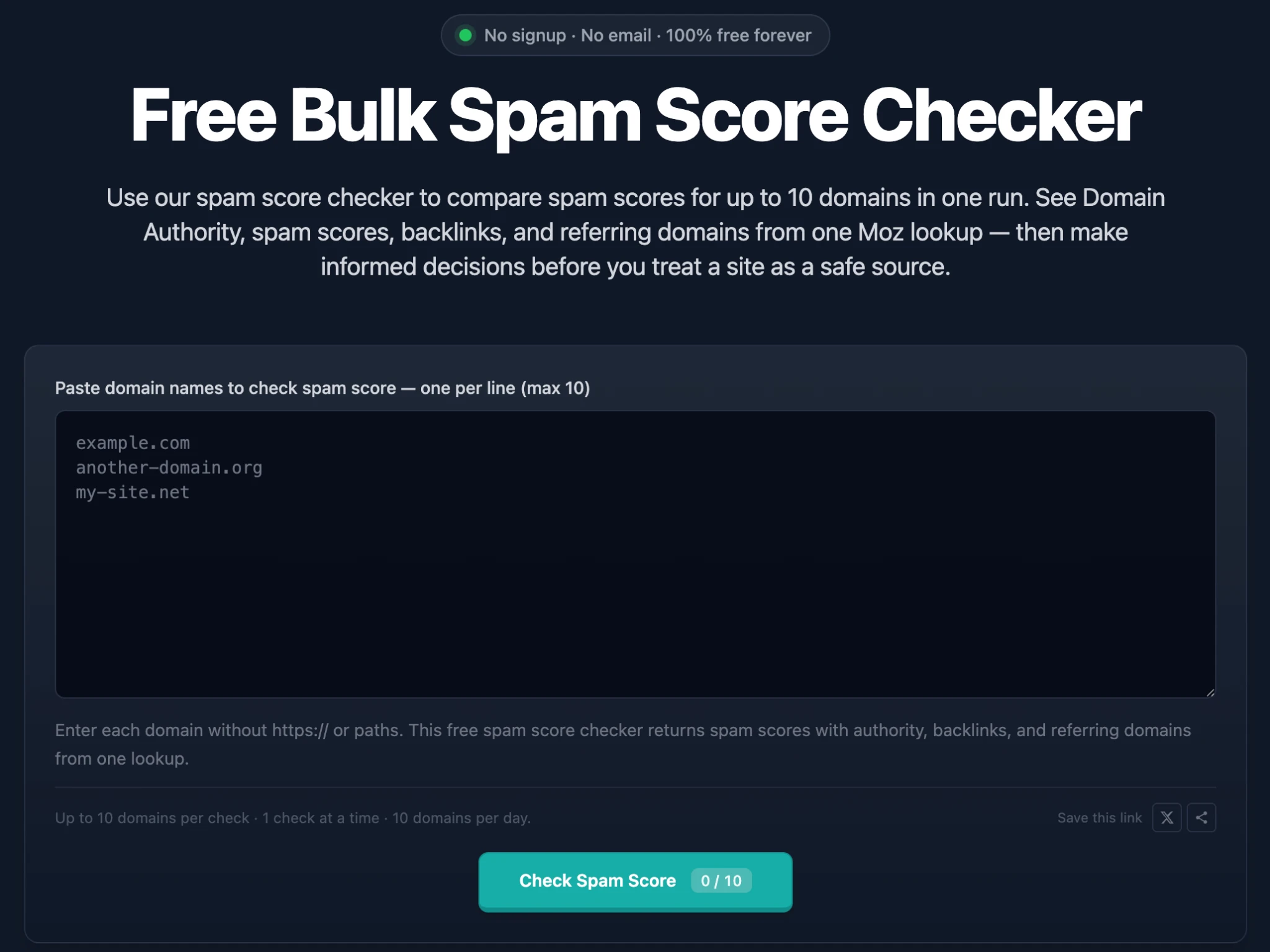
Bulk screening is helpful for outreach lists, backlink exports, auction candidates, and guest-post catalogs. I sort from highest Spam Score to lowest, then scan the authority and referring-domain columns for outliers.
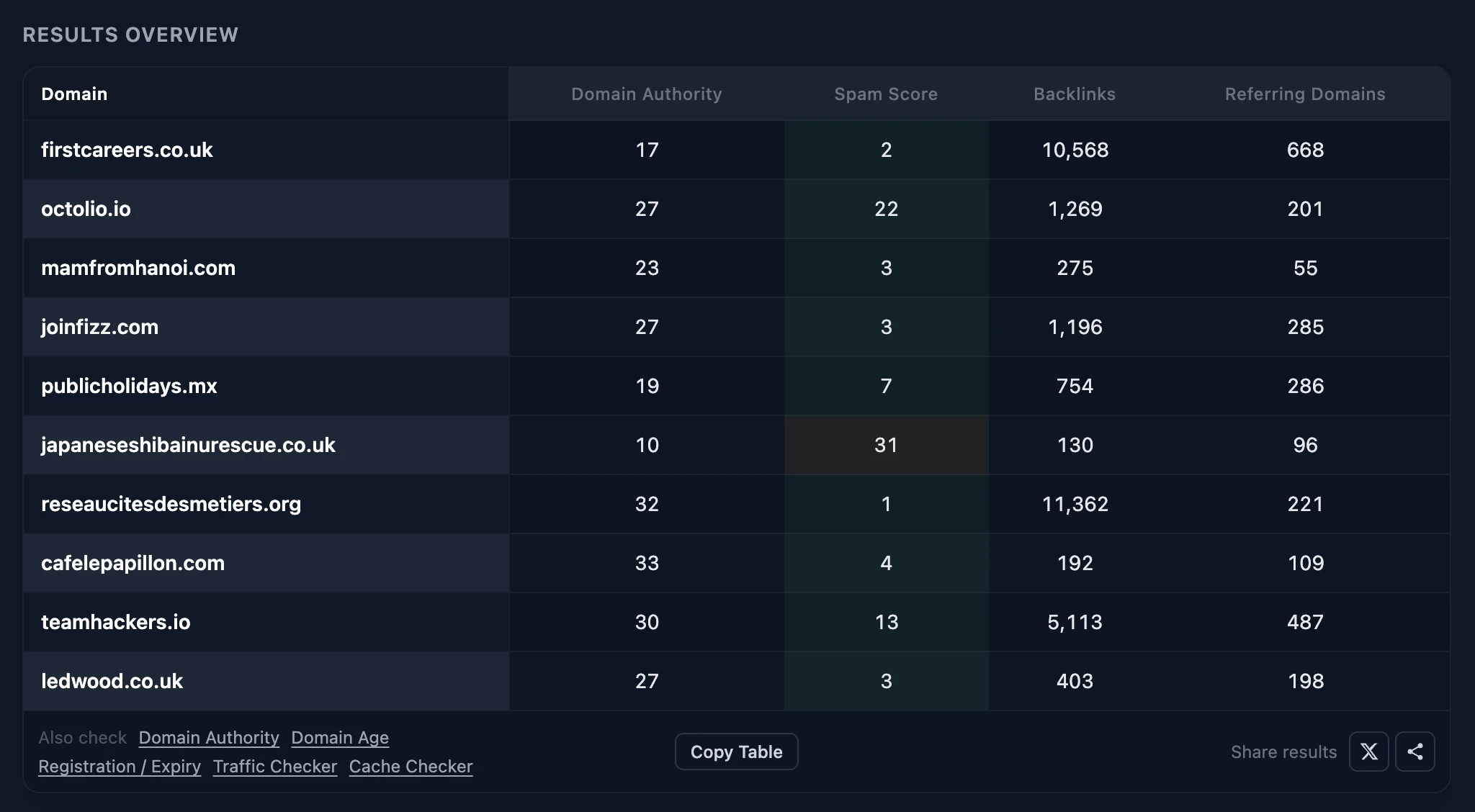
2. Compare authority with link diversity
Referring domains count the unique websites linking to a domain. Backlink count includes every discovered link, so one sitewide footer can create thousands of entries.
A high DA supported by many relevant referring domains deserves a different review from a high DA built on a few sitewide links. I look for concentration: how much of the apparent strength comes from one network, one template, or one group of related sites?
Network footprints matter here. A footprint is a repeated technical or editorial pattern that reveals common control, such as identical themes, analytics IDs, author bios, contact details, or outbound-link blocks.
3. Sample the actual backlinks
Metrics describe the profile. Linking pages explain it.
I open a sample of strong, recent, and suspicious backlinks. I check topical relevance, page quality, indexation, placement, and whether the link sits inside a real article or a generated list. A link from a relevant industry publication has a clearer reason to exist than a keyword-rich link buried in an unrelated foreign-language page.
4. Read the anchor-text distribution
Anchor text is the clickable wording of a backlink. A natural profile usually contains a mix of brand names, naked URLs, page titles, generic phrases, and some descriptive terms.
A heavy concentration of exact-match commercial anchors can reveal deliberate ranking campaigns. Exact match means the anchor repeats the target keyword word for word. In gambling, payday loans, pharma, and other aggressive SERPs, I expect more commercial anchors, so I compare the domain with genuine peers from the same niche.
Context wins again. Ten percent exact-match anchors may be ordinary in one market and alarming in another.
5. Inspect outbound links and current content
For a link prospect, I care about what the site links out to today. I review recent posts, categories, author pages, sponsored-content labels, and the range of commercial topics.
A site that publishes unrelated paid articles at high frequency is often called a link farm. Another clue is a sudden rise in posts that have no audience-facing purpose beyond hosting an outbound link.
I also check whether articles receive internal links. An orphan page has no meaningful internal path from the rest of the site. Even a clean domain can offer a weak placement if the new article will be orphaned.
6. Check the archive before trusting the present
A clean current design can cover an ugly history. I inspect archived versions for topic switches, parked periods, hacked pages, doorway content, and abrupt changes in language or ownership.
Doorway pages are thin pages created to rank for many similar queries and funnel visitors elsewhere. They often appear in large batches and leave clear patterns in old snapshots.
For expired or auction domains, I continue with Karma.Domains for researching expired domains and compare the archive, anchors, backlink sources, and spam signals before I consider a purchase.
7. Separate site risk from link risk
A suspicious domain does not make every historical link equally harmful. The page, link type, anchor, timing, and relationship to the target site all matter.
For my own backlink audit, I check Google Search Console for manual actions and review the links before touching a disavow file. Disavow tells Google to disregard specified backlinks. It is a blunt tool, so a third-party score by itself is a poor reason to use it.
How the process changes by job
Guest-post prospecting
I combine Spam Score with editorial relevance, organic visibility, recent post quality, outbound-link patterns, and likely page placement. A strong-looking metric row cannot compensate for a publisher whose business is selling links to any buyer.
Backlink cleanup
I use Spam Score to sort large exports and find clusters. A cluster might be dozens of domains with similar anchors, templates, registration patterns, or IP ranges. That pattern is more informative than one isolated high-scoring domain.
Then I review the links manually and document why each group is harmless, questionable, or clearly manipulative. This keeps an audit defensible when a client asks why a link was flagged.
Expired-domain buying
The downside is financial, so the bar rises. I want relevant historical content, a backlink profile that fits that content, stable archive activity, and no obvious repurposing into spam. A low Spam Score does not replace those checks.
Agency quality control
Agencies can turn the workflow into review lanes. Junior analysts handle low-risk candidates with a checklist, experienced reviewers examine medium-risk cases, and high-risk cases need a clear business reason to continue.
The Karma.Domains Expired Domains API and MCP can place the metric inside an internal prospecting process. MCP, or Model Context Protocol, lets ChatGPT, Claude, or another agent request the current result from a connected service. The automation should assign a review lane, never publish a final quality verdict.
Red flags I take seriously
- Commercial exact-match anchors dominate the backlink profile.
- A small set of related sites supplies most of the referring domains.
- The site publishes unrelated sponsored posts across several high-risk niches.
- Archive snapshots show a drop, ownership change, and complete topic switch.
- Strong authority metrics come with no search visibility and little original content.
- The strongest backlinks point to old pages that have no relevant replacement.
- The result is empty, but the domain is being presented as verified and clean.
One red flag starts a question. Several connected flags usually answer it.
A simple rule for beginners
Use Spam Score to order the work. Check the links, anchors, content, outbound placements, and archive before approving or rejecting the domain.
When a score worries me, I write down the evidence that explains it. If I cannot find that evidence, the number stays a warning rather than becoming a verdict.