




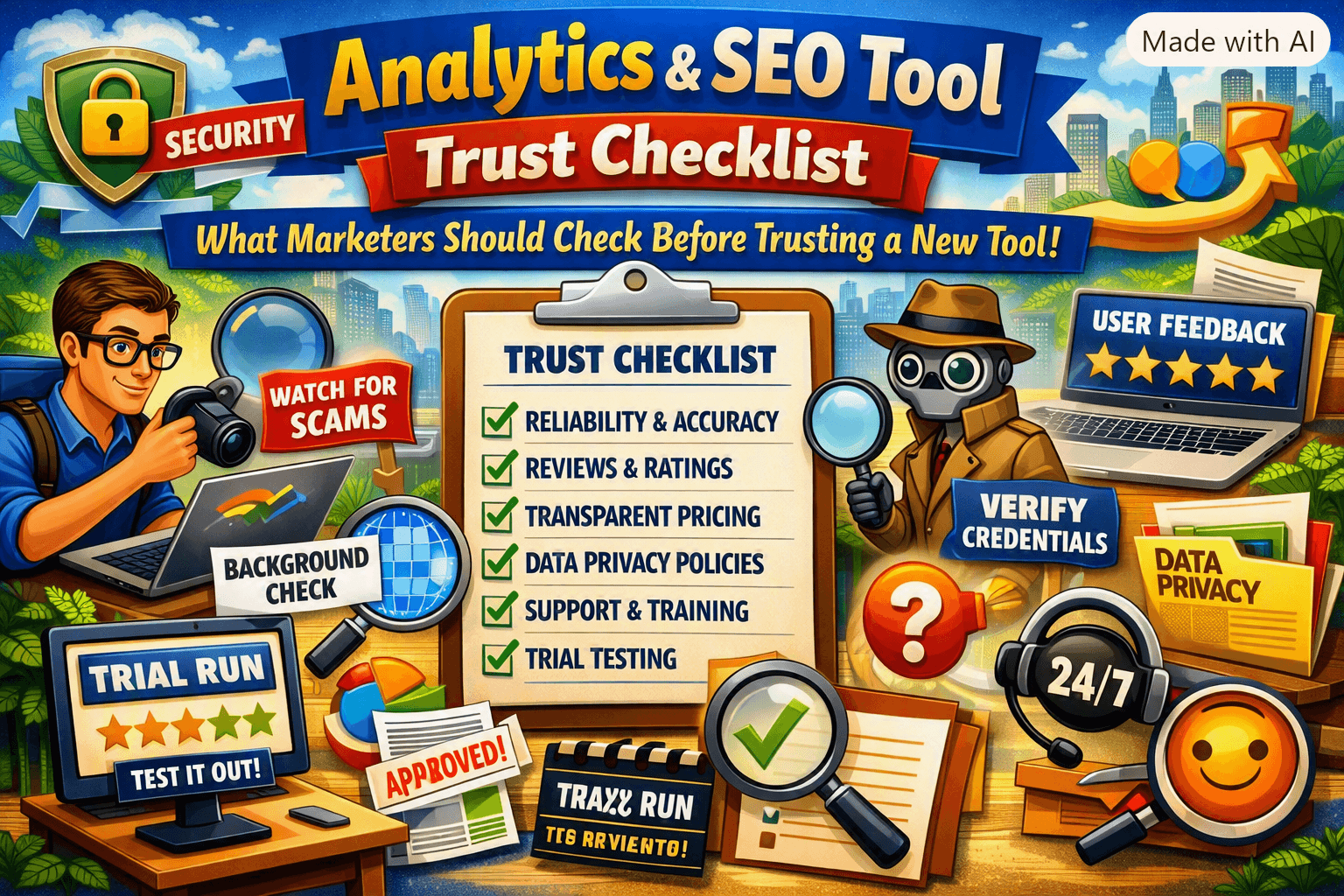
Marketing teams have access to hundreds of analytics, SEO, reporting, keyword research, and competitive intelligence tools. Many promise faster insights, better rankings, cleaner dashboards, or more accurate market data.
The challenge is deciding which tools deserve to influence real business decisions. An attractive interface or impressive feature list does not automatically mean the underlying data is accurate, complete, or appropriate for a particular workflow.
Before adopting a new platform, marketers should evaluate how the tool collects information, defines its metrics, handles limitations, and supports verification.
Start With the Exact Problem the Tool Should Solve
Do not begin with the feature list. Begin with the marketing problem.
A team may need keyword research, technical SEO auditing, backlink analysis, rank tracking, conversion reporting, competitor research, or campaign attribution.
A tool should be evaluated against that specific need rather than against the number of features it advertises.
Identify Where the Data Comes From
Marketers should understand whether data comes from direct website measurement, public search results, proprietary crawlers, third-party providers, panels, APIs, or modeled estimates.
Different collection methods produce different strengths and limitations.
A platform that explains its methodology clearly is easier to evaluate than one presenting numbers without context.
Check How Important Metrics Are Defined
Two SEO tools can use the same metric name while calculating it differently.
Terms such as traffic, visibility, authority, keyword difficulty, search volume, estimated clicks, or referring domains should have clear definitions.
Marketers should avoid comparing numbers from different tools as if their methodologies were identical.
Compare the Tool With Data You Already Trust
Before relying on a new analytics platform, test it against known information.
Compare several pages, keywords, traffic patterns, links, or conversion events with first-party systems and other established references.
The goal is not perfect agreement but understanding where and why differences appear.
Keep General Web Resources Separate From SEO Evaluation
Marketing research often involves official documentation, analytics platforms, search tools, industry publications, competitor websites, and general online references.
For broader Korean-language web navigation, users can keep a general 링크모음 separately, while analytics dashboards, SEO platforms, technical documentation, reporting tools, and campaign resources remain organized around marketing workflows.
This makes it easier to distinguish general browsing from the sources used for professional analysis.
Test Keyword Data With Real Queries
Keyword databases are estimates, not direct access to every search performed by users.
Select a mixture of large, medium, and niche queries that the team already understands and compare reported volume, trends, and related terms.
A useful tool should produce results that are directionally helpful even when exact estimates differ from another platform.
Evaluate Rank Tracking Carefully
Rank tracking depends on location, device, search engine, language, and sometimes personalization.
Marketers should verify which settings the platform supports and whether the tracking configuration matches the audience being measured.
A ranking number without geographic and device context can be misleading.
Check Technical SEO Crawl Accuracy
For crawling tools, test a site where several technical conditions are already known.
See whether the tool correctly identifies status codes, redirects, canonical tags, robots directives, duplicate pages, internal links, and indexability issues.
False positives should be easy to investigate rather than simply accepted as errors.
Understand Crawl Limits
Some tools crawl only a limited number of URLs or reduce functionality on lower plans.
Before adoption, check crawl limits, scheduling restrictions, JavaScript rendering, robots handling, and whether large websites require additional credits.
These limitations can affect the usefulness of the platform more than its headline feature list.
Examine Backlink Data Coverage
Backlink tools operate their own indexes and will rarely report identical link profiles.
Compare several known referring domains and recently acquired links to understand how frequently the platform discovers and refreshes them.
Also check whether the tool distinguishes links, referring pages, and referring domains clearly.
Look Beyond Proprietary Authority Scores
Authority-style metrics can be useful for comparison within the same platform, but they are not official search-engine scores.
Marketers should understand what factors contribute to the metric and avoid treating it as a direct ranking signal.
Raw link data and contextual analysis can provide important additional evidence.
Evaluate Historical Data
Historical information is valuable when analyzing trends or diagnosing a previous change.
Check how far back the platform retains rankings, keywords, backlinks, traffic estimates, or campaign data.
Also verify whether historical availability changes according to subscription level.
Check Update Frequency
SEO and marketing data becomes less useful when it is refreshed too slowly.
Ask how frequently rankings, backlinks, keyword databases, crawls, and competitive estimates are updated.
Different workflows may tolerate different delays, so the required freshness depends on the task.
Test Data Export Before Committing
A dashboard may look useful until the team needs to move the data elsewhere.
Check whether reports can be exported in practical formats and whether important fields remain available outside the platform.
Export limits, row limits, and additional charges should be understood before large workflows depend on the tool.
Review API Access
Teams automating reports or connecting multiple systems may eventually need an API.
Evaluate documentation, request limits, available endpoints, historical access, pricing, and authentication requirements.
An API that exposes only a small portion of dashboard data may not support the intended workflow.
Check Integrations With Existing Systems
A new platform should fit reasonably well with tools the team already uses.
Analytics platforms, advertising systems, search-performance data, dashboards, spreadsheets, CRM software, and reporting tools may all require integration.
Test important integrations rather than assuming they work because a logo appears on a feature page.
Examine Attribution Logic
Marketing attribution can change depending on how channels, sessions, conversions, and customer journeys are defined.
Teams should understand what attribution model the platform uses and whether historical results change when settings are modified.
Different attribution models can produce different answers from the same customer activity.
Check Conversion Tracking
If the platform measures conversions, test events that the team can verify independently.
Form submissions, purchases, calls, signups, or other important actions should be counted consistently.
Unexpected discrepancies should be investigated before reports are used for budget decisions.
Review Privacy and Data Handling
Analytics tools may process visitor, customer, or business data.
Marketers should understand what information is collected, where it is stored, how long it is retained, and what privacy controls are available.
Applicable organizational policies and legal requirements should also be considered before implementation.
Check User Permission Controls
Marketing platforms are often shared by agencies, employees, contractors, and clients.
Role-based permissions can prevent users from accessing or changing information they do not need.
Teams should test whether permissions are detailed enough for their actual workflow.
Look at Account Security
Useful security features may include multi-factor authentication, single sign-on, session controls, login history, and administrator permissions.
Security matters especially when a platform contains client data, campaign information, or integrations with other business systems.
Evaluate Reporting Flexibility
Different audiences need different reports.
An SEO specialist may need technical detail, while management may need trends, conversions, and business outcomes.
Check whether reports can be customized without rebuilding them manually every month.
Test Scheduled Reports
If scheduled reporting is important, test it during the trial period.
Verify formatting, date ranges, recipient controls, branding options, and whether reports contain enough context to be understood without opening the platform.
Check Documentation Quality
A sophisticated marketing tool can become difficult to use if its documentation is incomplete.
Look for explanations of metrics, data methodology, integrations, reports, APIs, troubleshooting, and account configuration.
Good documentation reduces dependence on support for routine questions.
Search the Help Center for Real Problems
Do not only read the introductory guides.
Search for questions that are likely to appear in everyday use, such as tracking discrepancies, crawl errors, missing keywords, API limits, or report configuration.
The quality of those answers can indicate how mature the product really is.
Evaluate Customer Support
Support quality matters when the platform becomes part of a daily workflow.
Check available channels, response expectations, support hours, and whether technical questions reach people who understand the product.
A complex platform with weak support can create significant operational friction.
Understand the Complete Pricing Model
Subscription price alone may not represent the real cost.
Additional charges may apply to users, projects, keywords, crawled pages, API calls, reports, exports, or historical data.
Estimate costs using the expected real workload rather than the smallest advertised plan.
Check What Happens When Usage Grows
A tool that works for one website may become expensive or restrictive when the team manages ten or fifty.
Review how limits scale with additional campaigns, clients, keywords, pages, or users.
This is particularly important for agencies and multi-site businesses.
Use the Trial Period for Real Work
A trial should be treated as an evaluation rather than a product tour.
Run a real site audit, track actual keywords, create a report, export data, connect an integration, and test a normal team workflow.
Real usage reveals problems that feature demonstrations rarely show.
Document Where the Tool Performs Well
No platform needs to be best at every marketing task.
A tool may have excellent technical crawling but average keyword data, or strong reporting but limited backlink coverage.
Recording these strengths helps teams use each platform for the jobs it performs best.
Document Known Weaknesses Too
Understanding limitations is part of trusting a tool.
If the team knows that a metric is delayed, estimated, geographically limited, or incomplete, it can interpret the data appropriately.
Unexplained limitations are more dangerous than known ones.
Avoid Making Decisions From One Metric
SEO and marketing performance is rarely captured by a single number.
Keyword visibility, traffic, conversions, links, technical health, revenue, and customer behavior provide different perspectives.
Important decisions should usually consider several relevant signals.
Keep First-Party Data Important
Competitive SEO platforms provide valuable estimates, but first-party information should remain central when it is available.
Website analytics, conversion systems, sales data, and direct search-performance information provide evidence that third-party estimates cannot completely replace.
Create a Simple Evaluation Scorecard
Teams comparing several tools can score each platform using the same criteria.
Useful categories include data quality, methodology transparency, keyword coverage, crawl accuracy, reporting, exports, integrations, security, documentation, pricing, and support.
A consistent scorecard helps prevent the most impressive demo from automatically winning.
Trust Comes From Verification, Not Features
A new analytics or SEO tool should earn trust through transparent methodology, useful documentation, verifiable data, practical exports, reliable integrations, and predictable limitations.
Marketers do not need every number from different platforms to match exactly. They do need to understand what each number represents and whether it is suitable for the decision being made.
By testing a tool against real websites and known data before adopting it, marketing teams can build a technology stack based on evidence rather than promises.