





An SEO Writer creates content designed to rank in search engines—blending keyword research, on-page optimization, and engaging prose to attract and keep targeted organic traffic. This role has moved far beyond simple article writing into a strategic, data-driven profession that mixes human creativity with AI-powered tools. Today’s SEO writers increasingly use an SEO writer like GEOWriter — a platform that handles live SERP analysis, content generation, E-E-A-T alignment, automated visuals, and publishing — to produce first drafts in minutes, freeing writers to focus on strategy, tone, and competitive differentiation.
What Is an SEO Writer? Core Responsibilities and Skills
An SEO Writer is a content professional who produces material optimized for both human readers and search engine algorithms. The main goal: generate content that informs and entertains, but also ranks well on Google and other engines. According to Yahoo! Finance, organic search drives roughly 53% of all website traffic, making SEO writing a critical function for digital marketing success. The Digital Marketing Institute adds that 75% of internet users never scroll past the first page of search results—so landing on page one isn’t optional.
Four foundational pillars define the modern SEO Writer’s role:
- Keyword Research: Pinpointing the specific terms and phrases your target audience uses to find information, products, or services.
- Content Strategy: Planning a structured approach to content creation that aligns with business goals and user needs.
- On-Page SEO: Optimizing individual pages through meta tags, headings, internal linking, and content structure.
- Search Intent: Understanding the underlying goal behind a user’s search query—whether they want to learn, buy, compare, or navigate.

Why Search Intent Is the New SEO Superpower
Search intent has become the most critical factor in content success. An SEO Writer must distinguish between four primary intent types: informational (seeking knowledge), navigational (finding a specific site), commercial (researching before purchase), and transactional (ready to buy). Matching content to the correct intent directly affects bounce rates, engagement, and rankings. A page optimized for the wrong intent will fail to satisfy users, no matter how well you place keywords or handle technical optimization.
From Keyword Research to Content Strategy: A Practical View
Keyword research is the starting point, not the end goal. An SEO Writer must turn raw keyword data into a coherent content strategy. This means grouping related keywords into topic clusters, spotting content gaps in the current SERP landscape, and prioritizing topics based on search volume, competition, and business relevance. A practical workflow: use tools like Google Keyword Planner or SEMrush to discover opportunities, then map those keywords to specific content formats—blog posts, landing pages, guides.
The Modern SEO Writer Is a Workflow Architect
The old view of an SEO Writer as a keyword-stuffer or a simple article writer is outdated. In 2026, the most effective SEO Writers operate as workflow architects, designing and managing a human-AI collaborative process that balances speed with quality. This approach lets writers scale content production without sacrificing strategic depth or editorial standards.
The core workflow has four repeatable steps:
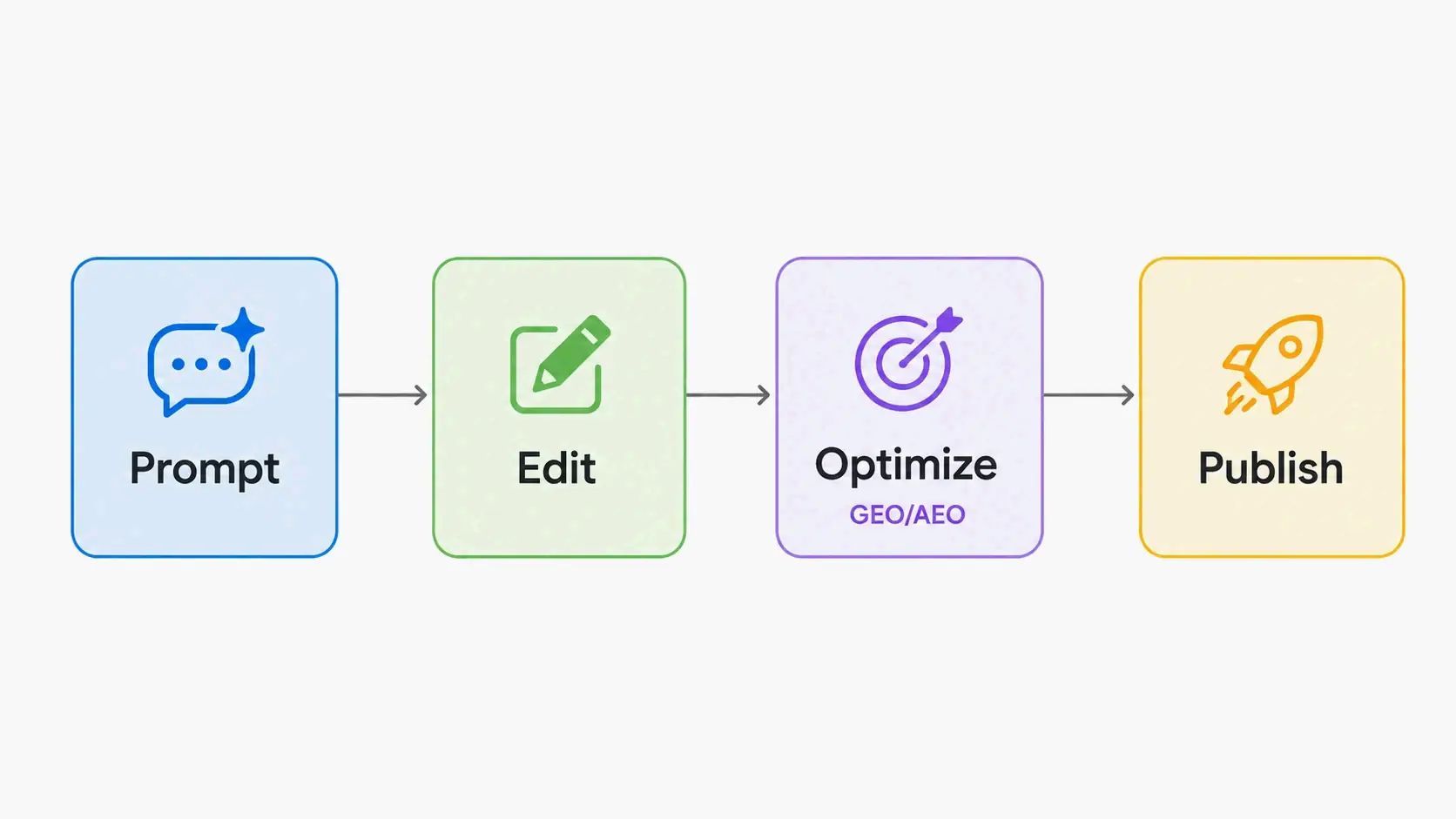
Step 1: Create a High-Quality AI Prompt for Drafting Content
The quality of the AI output depends entirely on the quality of the input. A strong prompt includes the target keyword, search intent, target audience, article angle, heading structure, key entities to cover, internal linking requirements, tone guidelines, and EEAT (Experience, Expertise, Authoritativeness, Trustworthiness) requirements. Instead of a vague prompt like “write a blog on SEO writing,” a powerful prompt might specify: “Write a practical guide for marketing managers on building an SEO content workflow. Include a step-by-step process, tool recommendations, and a checklist for human editing. Use a professional but accessible tone.”
Step 2: The Essential Human Editing Checklist (10–15 Items)
AI drafts are raw material, not finished content. Before publishing, every SEO Writer should run through a comprehensive editing checklist that includes:
- Does the introduction directly answer the main query?
- Is the content aligned with the dominant search intent?
- Are keywords used naturally without stuffing?
- Have generic filler sentences been removed?
- Are all facts, statistics, and external references verified?
- Does the content include original examples or practical experience?
- Are internal links added to relevant cluster pages?
- Are headings structured for both users and featured snippets?
- Is the call-to-action clear and contextually appropriate?
- Is the content connected to a broader topical strategy?
Step 3: Optimizing for Generative Engine Optimization (GEO) and AEO
Search visibility now extends beyond traditional search engine results pages (SERPs). Answer Engine Optimization (AEO) focuses on making content easy for AI assistants and voice search systems to extract as clear, concise answers. Generative Engine Optimization (GEO) targets AI-powered search overviews and generative search experiences. Practical optimization techniques: use question-led headings, write direct answer paragraphs early in the content, cover entities comprehensively, and structure information in tables or bullet points. These practices make content more accessible to both human readers and AI-powered retrieval systems.
Top Tools Every SEO Writer Needs in 2026: From Keyword Research to GEO
The right tools are essential for executing an efficient SEO writing workflow. Three categories of tools address different stages of the process: discovery, drafting, and optimization. For teams that want a single platform covering all three stages, GEOWriter — an AI SEO content writer — combines live SERP analysis, structured content generation, E-E-A-T alignment, automated visuals, and one-click publishing into one workflow.
- SEMrush provides extensive keyword research capabilities, competitive analysis, and content marketing features. It helps SEO Writers identify high-opportunity keywords, analyze competitor strategies, and track organic performance over time.
- Surfer specializes in on-page content optimization. As one user quoted on the Surfer website notes, “I love using Surfer because it allows me to scale on-page optimization in the most effective way possible. Creating SEO-driven briefs is a snap with Content Editor and writers love it because of how straight-forward the recommendations are.”
- SE Ranking offers a comprehensive platform covering rank tracking, website audits, keyword research, and AI visibility monitoring. According to SE Ranking’s website, the platform allows users to “track visibility. Validate it,” providing cross-channel context to prove the value of every decision across SEO, GEO, and social.
Why Surfer and SEMrush Are Non-Negotiable for On-Page SEO
On-page optimization remains a core competency for SEO Writers. Surfer’s Content Editor provides real-time recommendations for keyword usage, content length, headings, and structure based on analysis of top-ranking pages. SEMrush complements this with deeper keyword clustering, search intent classification, and content gap analysis. Together, they form a powerful combination: SEMrush for strategic discovery and Surfer for tactical execution.
The Emerging Role of GEO and AEO Tools in Content Optimization
As AI-powered search experiences grow, dedicated monitoring tools are becoming necessary. SE Ranking, for example, now includes AI Visibility features that track brand mentions and rankings across AI search engines, including Google AI Overviews and ChatGPT. This lets SEO Writers measure how their content performs in generative search contexts, not just traditional SERPs. These tools help answer questions like: “Is my content being cited by AI assistants?” and “Which topics need optimization for AI visibility?”
How to Become a High-Paid Remote SEO Writer
The demand for skilled SEO Writers continues to grow, and remote opportunities command competitive compensation. According to Dynamite Jobs, the current average salary range for a remote SEO Writer is around $3.9k–$5.5k per month, with some companies offering salaries as high as $9.2k per month. To reach the higher end of this range, writers need to develop specialized skills that command premium pay.
The top skills that differentiate high-paid SEO Writers include:
- Deep experience with search intent analysis: Going beyond keywords to understand user psychology and content purpose.
- Technical SEO fundamentals: Understanding page speed, structured data, crawlability, and indexation basics.
- Proven ability to drive organic growth: A track record of increasing traffic, rankings, and conversions through content strategy.

Remote job opportunities are plentiful on platforms like Dynamite Jobs, Upwork, and specialized remote job boards. Companies like WebFX, Siege Media, and Typeform frequently hire remote SEO writers and editors.
Do You Need to Be an Expert in Technical SEO?
Not necessarily. Fundamental SEO knowledge—keywords, on-page optimization, and search intent—is essential. Deep technical SEO is typically handled by specialists. But understanding technical basics like page speed, structured data, and canonical tags can set you apart and help you collaborate more effectively with technical teams. This knowledge also lets you spot content-related technical issues before they impact ranking performance.
Building a Portfolio That Shows Results (Not Just Words)
A portfolio focused on output metrics, not just writing samples, is more persuasive to employers and clients. Include case studies that demonstrate:
- Organic traffic growth before and after content optimization.
- Keyword ranking improvements for specific target terms.
- Featured snippet acquisition or AI Overview visibility.
- Conversion rate increases tied to content strategy changes.
For each project, explain the problem, your approach, the tools used, and the measurable outcome. This evidence-based approach proves you can deliver business value, not just produce articles.
Conclusion
An SEO Writer in 2026 is a workflow architect who blends human expertise with AI tools to create content that ranks, engages, and converts. Success depends on mastering search intent analysis, building repeatable human-AI collaboration workflows, and understanding emerging optimization areas like GEO and AEO. For the content production piece, GEOWriter — an AI SEO content writer — combines SERP analysis, content generation, E-E-A-T alignment, automated visuals, and publishing into a single platform built for consistent, long-term visibility. Start by mastering one workflow step: practice SERP analysis on a single topic, refine an AI prompt for your next article, or apply a 5-point editing checklist to existing content. Each small improvement builds toward a more strategic, scalable, and impactful SEO writing practice.
FAQ
What is the average salary for a remote SEO Writer?
According to Dynamite Jobs, the average monthly salary ranges from $3.9k to $5.5k for remote SEO Writers. Top earners can make up to $9.2k per month. Salary varies based on experience, niche expertise, and proven results in driving organic traffic.
Do I need to be an expert in technical SEO to be an SEO Writer?
Not necessarily. Fundamental SEO knowledge (keywords, on-page optimization, search intent) is essential, but deep technical SEO is typically handled by specialists. However, understanding technical basics like page speed and structured data can set you apart and help you collaborate better with technical teams.
Is AI replacing the need for human SEO Writers?
No. AI is a powerful tool for drafting and research, but it cannot replace human creativity, strategic thinking, or deep subject-matter expertise. The best SEO writers use AI as a collaborator, focusing their time on high-value tasks like SERP analysis, voice curation, and aligning content with business goals.